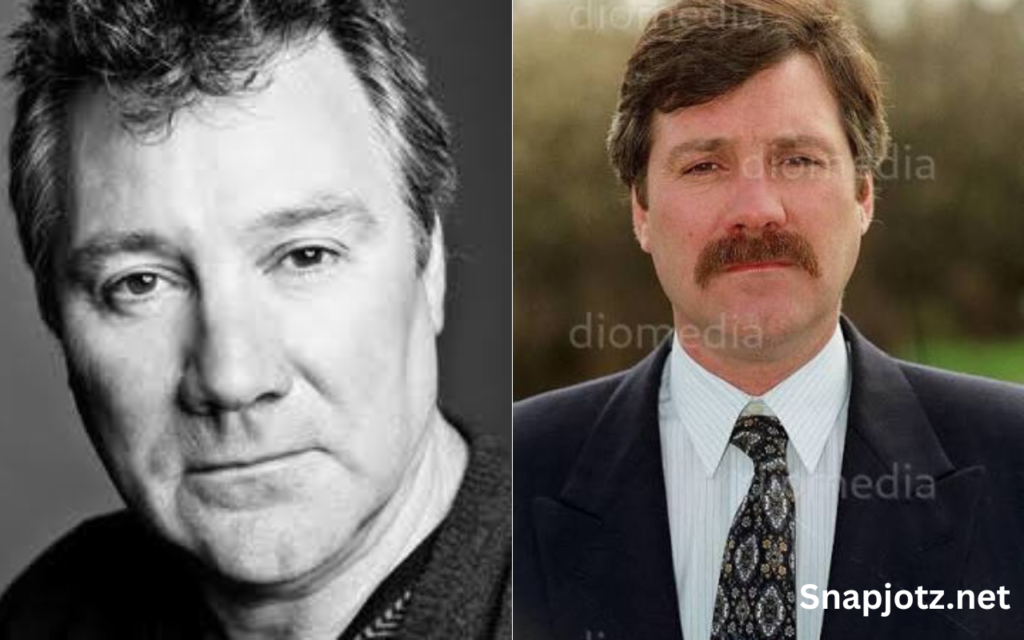

John Duttine is the kind of British actor whose career becomes more impressive the further you look into it. For some viewers, he will always be remembered as Sergeant George Miller from Heartbeat, while others recognize him as Bill Masen from the BBC’s celebrated The Day of the Triffids or David Powlett-Jones from To Serve Them All My Days. Yet those famous roles represent only part of a professional journey that has included theatre, television, film, radio and voice work across more than five decades. Born in Barnsley and raised in Bradford, Duttine developed from a Yorkshire schoolboy with an early interest in acting into one of Britain’s dependable and respected character performers.
What makes John Duttine particularly interesting is the consistency of his career. He never needed to depend on one blockbuster film or a single long-running role to maintain his reputation. Instead, he built his standing gradually through demanding dramatic performances, literary adaptations, historical productions, police dramas and theatre. His career illustrates the traditional British acting route in which training, repertory theatre and television gradually combine to create a performer capable of moving between very different characters. From his early work in Glasgow theatre to his later appearances in productions such as Father Brown, Vera, WPC 56 and Paranoid, Duttine has repeatedly demonstrated that versatility can be just as valuable as celebrity.
There is also a quieter personal story behind his professional achievements. Duttine experienced the loss of his father while he was still a young child, grew up as the youngest of five sons and eventually pursued acting after realizing during his teenage years that performance was the field in which he felt most capable. He trained at the Drama Centre London, worked in repertory theatre and then moved into television during the 1970s. His marriage to actress Mel Martin added another connection between his personal and professional worlds, while his nephew Joe Duttine later established a successful acting career of his own.
John Duttine Quick Facts
| Category | Details |
|---|---|
| Full Name | John Arthur Duttine |
| Date of Birth | March 15, 1949 |
| Age | 77 in 2026 |
| Birthplace | Barnsley, South Yorkshire, England |
| Nationality | British |
| Profession | Actor |
| Years Active | 1973–present |
| Education | Buttershaw High School; Drama Centre London |
| Father | Josef Duttine |
| Mother | Caroline Edith Duttine, née Hampton |
| Siblings | Four brothers |
| Spouse | Actress Mel Martin |
| Marriage | 1998 |
| Child | Oscar James Duttine |
| Nephew | Actor Joe Duttine |
| Best Known Roles | David Powlett-Jones, Bill Masen, Sergeant George Miller |
| Major Award | TV Times Best Actor for To Serve Them All My Days |
| Net Worth | Not reliably disclosed publicly |
| No verified official account reliably identified | |
| X/Twitter | No verified official account reliably identified |
| No verified personal account reliably identified |
John Duttine’s Early Life and Yorkshire Childhood
John Arthur Duttine was born on March 15, 1949, in Barnsley, South Yorkshire. Although Barnsley was his birthplace, his childhood was largely associated with Bradford, particularly the Buttershaw area, where he grew up with his four brothers. He was the youngest of five sons, and his early family circumstances were shaped by the death of his father when John was only five years old. These details provide important context for understanding the relatively ordinary Yorkshire background from which one of Britain’s long-serving professional actors eventually emerged.
Duttine attended Buttershaw High School in Bradford, and acting became increasingly important to him during his teenage years. According to biographical information associated with his career, he eventually came to the realization that acting was the thing he did best. That realization appears to have been an important turning point because instead of simply pursuing a conventional career path, he committed himself to professional theatrical training. His upbringing was far removed from the glamour sometimes associated with the entertainment industry, making his eventual success an especially interesting example of determination and professional development.
The Yorkshire environment also became an understated part of Duttine’s identity as an actor. His northern background would later contrast intriguingly with characters from Wales, London and other parts of Britain. In To Serve Them All My Days, for example, he had to portray a Welsh character and work carefully on the accent. His own comments about being concerned about getting the Welsh voice right show how seriously he approached regional authenticity, something that became an important element of his acting technique.
Education and Training at the Drama Centre London
After deciding to pursue acting professionally, Duttine trained at the Drama Centre London. The school was associated with intensive actor preparation, giving students a demanding environment in which to develop character work, voice, movement and performance discipline. For Duttine, this training provided the bridge between an interest in acting and a genuine professional career. Rather than entering television without experience, he developed his craft through structured training and theatre work.
His first professional job after drama school was particularly demanding. He performed three different characters in Hamlet for the Citizens Theatre Company in Glasgow. He then joined the Glasgow Repertory Company and undertook a variety of substantial classical and dramatic roles, including Antony in Antony and Cleopatra, Danton in Danton’s Death and Danforth in The Crucible. This repertory background gave him exposure to very different styles of characterization and helped develop the flexibility that later became one of the defining features of his television career.
The repertory system also taught actors an important lesson about professionalism: every role matters, whether the production is prestigious or relatively small. Duttine’s later career reflects that philosophy. He has repeatedly moved between leading parts and supporting roles without appearing to be confined by one category. His early stage experience provided a strong foundation for the controlled, naturalistic performances that audiences would later see in British television dramas and adaptations.
John Duttine’s Television Career Begins
Duttine began making his mark on television during the early 1970s. One of his notable early credits was the BBC adaptation of A Pin to See the Peep Show in 1973, where he appeared opposite Francesca Annis. Other early television work included productions such as The Nine Tailors, Rooms, Z-Cars, Angels and Warship. These appearances gave him the opportunity to build screen experience while gradually becoming familiar to British television audiences.
A significant step came in 1977 when Duttine appeared as John the Apostle in the large international television production Jesus of Nazareth. The miniseries assembled an impressive cast and exposed Duttine to a production environment on a much larger scale than many of his earlier British television appearances. He later described the experience of spending months filming in North Africa as difficult but valuable because it offered insight into the enormous scale of international filmmaking.
The period also brought roles in ambitious British productions. Duttine portrayed Keith Nicholson in Spend, Spend, Spend, based on the remarkable story of football pools winner Vivian Nicholson, and played the future King John in the historical drama The Devil’s Crown. He subsequently appeared as Earnshaw in the 1978 adaptation of Wuthering Heights. These roles demonstrated that television producers were increasingly willing to trust him with substantial parts in serious and prestigious dramas.
To Serve Them All My Days: The Role That Changed His Career
The most important breakthrough of Duttine’s early career came with the BBC’s 1980 adaptation of R. F. Delderfield’s To Serve Them All My Days. The thirteen-episode drama followed David Powlett-Jones, a Welsh schoolmaster whose life was shaped by the First World War, education and the changing society of twentieth-century Britain. Duttine took the central role and carried the series through a demanding character journey.
The role required considerably more than simply learning dialogue. Duttine had to convincingly portray a Welsh character despite his Yorkshire origins, and the accent became one of his major concerns during preparation. His attention to regional speech helped make the performance convincing. The series became one of the most important productions of his career, and contemporary critical reaction was highly favorable, with the New York Times describing him as exceptional when the series reached American audiences.
Duttine’s performance also earned major recognition. He won the TV Times Best Actor award for the role, while Encyclopedia.com records both a Thames Television Award and a TV Times Award for best actor associated with To Serve Them All My Days. The success established him as a serious leading television performer and created the professional momentum that would carry him into some of the most memorable British productions of the 1980s.
The Day of the Triffids and Science-Fiction Success
Only a year after To Serve Them All My Days, Duttine took on another highly significant role when he played Bill Masen in the BBC’s 1981 adaptation of John Wyndham’s The Day of the Triffids. The story imagined a world devastated after most of humanity is blinded by a mysterious astronomical phenomenon, leaving survivors to confront deadly mobile plants known as triffids. Duttine’s Bill becomes one of the central figures attempting to survive and understand the new world.
The production developed a strong reputation among British science-fiction audiences and eventually became regarded as a cult favorite. Duttine’s performance was particularly effective because he approached the extraordinary circumstances with seriousness rather than exaggeration. The result was a believable protagonist trapped inside a highly unusual story, demonstrating that his acting abilities were not restricted to conventional historical or contemporary drama.
The role also strengthened Duttine’s reputation as an actor capable of carrying ambitious television productions. Coming so soon after his award-winning performance in To Serve Them All My Days, The Day of the Triffids showed that he could move successfully from historical drama into science fiction without losing credibility. His filmography from this period therefore became an important foundation for the wider reputation he would maintain throughout his career.
John Duttine’s Career Through the 1980s and 1990s
Following the success of his major early television roles, Duttine continued to work steadily throughout the 1980s. His credits included The Outsider, a six-part ITV drama set in Yorkshire, as well as numerous other television productions. He also returned to the stage, demonstrating that despite his growing screen profile he had not abandoned the theatrical foundations of his career.
The 1990s continued this pattern of variety. Duttine took on roles in productions including Out of the Blue, where he played DI Eric Temple, Touching Evil, where he portrayed Michael Hawkins, and The Jury, in which he played Mark Waters. He also appeared in comedy and drama, demonstrating that his range extended well beyond the serious historical performances that had initially made him prominent.
He also continued his connection with theatre. In 1989, he was reunited with Charles Kay, who had played his adversary in To Serve Them All My Days, when they appeared in the original cast of The Woman in Black. Years later, Duttine toured in Art with Les Dennis and Christopher Cazenove. These stage projects reinforced the theatrical side of his professional identity and showed that his career was never exclusively dependent on television.
John Duttine and Heartbeat
For a large modern audience, one of Duttine’s most recognizable roles is Sergeant George Miller in the ITV drama Heartbeat. Interestingly, his connection with the series began before he became a regular cast member. In 1992, he appeared as guest character Paul Melthorn. More than a decade later, he returned to the programme in the regular role of Sergeant George Miller.
George Miller gave Duttine an opportunity to portray a very different kind of character from David Powlett-Jones or Bill Masen. As a police sergeant in the fictional Yorkshire community of Aidensfield, Miller represented authority, experience and traditional policing. Duttine’s restrained performance fitted naturally into the show’s nostalgic atmosphere and helped make the character believable rather than exaggerated.
Duttine played Sergeant Miller during the 2000s, with IMDb identifying his regular tenure as running from 2005 to 2009. His association with Heartbeat became an important part of his later television identity, particularly for viewers who discovered his work through British period drama and reruns. The role also demonstrated the unusual longevity of his screen career: decades after his first television appearances, he remained a recognizable and trusted performer.
Later Television Roles and Continued Acting Work
Duttine remained active in British television after Heartbeat. His later credits included Douglas Taylor in WPC 56, Eric Benton in Paranoid and George Hammond in Father Brown. He also appeared in productions such as The Paradise and Vera. These roles demonstrate that his career continued well beyond the television series that first made him widely known.
One of the strongest characteristics of this later period is Duttine’s willingness to accept supporting and guest roles. Rather than attempting to reproduce the leading-man career of his early years, he adapted naturally to the changing television landscape. Modern British drama increasingly relies on large ensembles and recurring character actors, and Duttine’s experience made him particularly well suited to this environment.
His continued presence across crime drama, mystery series, historical programmes and character-driven television also reflects the trust that comes with experience. Directors and producers can rely on an actor with decades of training to establish a believable character quickly. Duttine’s later career therefore illustrates another form of success: not constant celebrity attention, but continued professional relevance.
John Duttine’s Theatre Career and Voice Work
Although television eventually became the most visible part of his career, theatre remained an important element of Duttine’s professional life. His early repertory experience in Glasgow gave him a foundation in classical drama, and he continued returning to the stage after establishing himself on screen. This theatrical connection helped preserve the disciplined approach to character work that had defined his early career.
One notable later stage project was Art, which Duttine toured in 2003 with Les Dennis and Christopher Cazenove. His involvement in stage productions demonstrates that he remained comfortable performing live, where there are no opportunities to repeat a scene for editing or hide behind multiple takes. For an actor whose career was built partly on theatre, this continued stage work was a natural extension of his professional identity.
Duttine has also worked with his voice beyond conventional acting roles. Biographical material credits him with voice-over work for advertisements and documentaries as well as radio plays for the BBC. His voice, shaped through decades of stage and screen performance, provided another professional avenue and showed that his skills extended beyond appearing in front of a camera.
John Duttine’s Marriage, Family and Personal Life
Duttine has generally maintained a comparatively private personal life. He had a long-term relationship with Carolyn Hutchinson, and they had a son, Oscar James Duttine, in 1981. Later, Duttine began a relationship with actress Mel Martin, whom he had met while working on the television adaptation Talking to Strange Men in 1992. Their professional relationship eventually developed into marriage.
Duttine and Mel Martin married in 1998. Martin is herself an experienced British actress whose credits include Persuasion, White Hunter Black Heart, Cold Feet and other television productions. The couple’s relationship therefore developed between two people who understood the demands and uncertainty of professional acting. They also worked together on screen in several productions, including Talking to Strange Men, Casualty and EastEnders.
The couple also shared an interest in life away from the entertainment industry. Biographical accounts describe them buying an eighteenth-century farmhouse in Cornwall, where Duttine reportedly became deeply involved in practical renovation work, including rewiring, plumbing, cabinetry and gardening. This detail offers a fascinating contrast with his professional image: away from television studios and theatres, he has been described as a hands-on and practical person.
John Duttine and Nephew Joe Duttine
Acting became a family tradition in an unexpected way through Duttine’s nephew, Joe Duttine. Joe, born Jonathan Duttine in 1970, later developed a successful career of his own and became particularly well known for playing Tim Metcalfe in ITV’s Coronation Street. He is the son of John Duttine’s brother Geoffrey.
The family connection is especially interesting because Joe also trained at the Drama Centre London, following a similar professional route to his uncle. According to biographical material, Joe used the professional name Joe rather than John because his uncle was already established under the name John Duttine. This small detail shows how one actor’s established identity could influence the professional choices of the next generation.
Despite their shared profession, the two actors have developed distinct identities. John Duttine built his reputation through major television dramas, theatre and character roles beginning in the 1970s, while Joe’s career belongs to a later generation and includes prominent work in contemporary British television. Together, their careers represent an interesting link between different eras of British acting.
John Duttine Net Worth and Sources of Income
There is no reliable publicly verified figure for John Duttine’s personal net worth. Celebrity wealth websites sometimes publish precise estimates, but without access to his private contracts, investments, property valuations, pension arrangements and other financial information, such figures should not be treated as confirmed facts. A responsible biography should therefore avoid presenting an invented number as though it were official.
Duttine’s long professional career has provided several potential income streams. These include television acting, feature films, theatre productions, radio drama, voice-over work and advertising-related voice performances. His extensive list of credits shows a sustained professional career, but the number of credits alone cannot be converted into an accurate personal fortune because individual acting fees and contractual arrangements are generally private.
For that reason, the most accurate statement about John Duttine’s finances is that his net worth has not been reliably disclosed in authoritative public sources. Rather than repeating an unsupported estimate, it is more useful to recognize the financial stability that can potentially come with a career lasting more than five decades, while acknowledging that the precise value of his assets and earnings remains private.
John Duttine on Social Media
John Duttine belongs to a generation of actors who established their careers long before social media became an essential part of celebrity culture. Unlike many contemporary performers, he does not appear to have a widely recognized and reliably verified personal Instagram, X/Twitter or LinkedIn account. This means that profiles using his name should not automatically be assumed to be official.
His relatively low online profile is consistent with the private nature of his public life. Duttine’s professional reputation was built through television credits, theatre performances, interviews and traditional entertainment media rather than through constant online engagement. His career demonstrates that an actor can maintain a substantial cultural presence without maintaining a highly visible personal social-media brand.
For people wanting to follow his work today, established film and television databases and reputable entertainment publications remain more dependable sources than unverified social-media pages. His extensive screen credits can be traced through professional databases such as IMDb, while individual television productions provide additional information about his appearances.
John Duttine’s Acting Style and Professional Reputation
Duttine’s acting style is often strongest when he is playing believable people rather than larger-than-life personalities. His performances tend to favor control, realism and subtle emotional detail. That approach proved particularly effective in To Serve Them All My Days, where he had to portray a character whose life and outlook changed substantially over many years. The success of that performance helped establish his reputation as an actor capable of carrying serious dramatic material.
His versatility is perhaps an even more important part of his legacy. He has played historical figures, schoolmasters, police officers, survivors, detectives, professionals and supporting characters across very different genres. His career includes literary adaptations, science fiction, historical drama, crime television, comedy and stage productions. Such variety is difficult to maintain over a long career and speaks to the strength of his training and adaptability.
Another important feature of his reputation is longevity. Duttine did not disappear after the success of To Serve Them All My Days or The Day of the Triffids. Instead, he continued accepting challenging roles for decades. His later appearances in programmes such as Heartbeat, Vera, Father Brown, WPC 56 and Paranoid show how he successfully moved from leading roles in earlier decades into the increasingly important world of experienced character acting.
What Is John Duttine Doing Now?
John Duttine’s public profile in recent years has been considerably quieter than during the periods when he was leading major television dramas. Available filmography sources document substantial later work, including appearances in Father Brown, Paranoid, WPC 56, The Paradise and Vera. However, there is no reliable public information establishing a major new project that should be described as his definitive current undertaking in 2026.
That lack of frequent headlines should not be mistaken for a clearly documented retirement. Duttine has historically moved between screen work, theatre and voice performance, and his private approach to public life means that information about his personal plans is limited. Without a confirmed statement from Duttine or a highly reliable current source, claims about retirement, future projects or personal plans would be speculative.
What can be said with confidence is that his existing body of work continues to have a life of its own. Classic British television is regularly rediscovered by new viewers, and productions such as To Serve Them All My Days, The Day of the Triffids and Heartbeat continue to attract interest. That means Duttine’s influence does not depend entirely on new appearances; his earlier performances remain part of British television history.
John Duttine’s Legacy in British Television
John Duttine’s legacy is best understood through the variety and durability of his work. His career began with theatre training and repertory performances before moving into television during the 1970s. Within a relatively short period, he was appearing in major historical productions, literary adaptations and international projects. His breakthrough as David Powlett-Jones then established him as a serious leading performer, while The Day of the Triffids proved he could successfully carry science-fiction drama.
Later, roles such as Sergeant George Miller in Heartbeat introduced him to another generation. His appearances in modern British crime and mystery programmes demonstrated that his skills remained useful as television changed. Rather than being remembered for only one era, Duttine became a performer whose career connected several generations of British television. That continuity is one of the strongest indicators of professional success.
Perhaps the most valuable lesson from his career is that lasting recognition can be built through consistency rather than constant publicity. Duttine’s story is not simply about becoming famous; it is about learning the craft, accepting different kinds of roles, remaining adaptable and continuing to work. His journey from a Bradford schoolboy to an award-winning television actor demonstrates how patience and professional discipline can create a career that remains relevant long after an individual performance has ended.
Conclusion: The Enduring Story of John Duttine
John Duttine’s career represents one of the most compelling forms of British acting success: the ability to remain respected and professionally relevant across generations. From his childhood in Yorkshire and training at the Drama Centre London to his early repertory work, his breakthrough in To Serve Them All My Days, his science-fiction success in The Day of the Triffids and his later popularity in Heartbeat, every stage of his career added another dimension to his reputation.
His personal story adds another layer to that professional journey. He grew up as the youngest of five sons, experienced the loss of his father as a child, established a long career through discipline and training, and eventually married fellow actress Mel Martin. His family connection to actor Joe Duttine further illustrates the lasting influence of acting within his family. Yet despite decades in the public eye, John Duttine has largely maintained a private and understated profile.
Ultimately, John Duttine’s legacy is not defined by celebrity gossip, social-media popularity or an easily calculated net worth. It is defined by the characters he brought to life and the trust he earned from audiences and producers over more than fifty years. His career reminds aspiring performers that success can be built slowly, through preparation, versatility and persistence. As John Duttine’s work continues to be rediscovered by audiences interested in classic British television and theatre, his journey stands as a lasting reminder that resilience, craftsmanship and genuine passion can create a meaningful legacy.