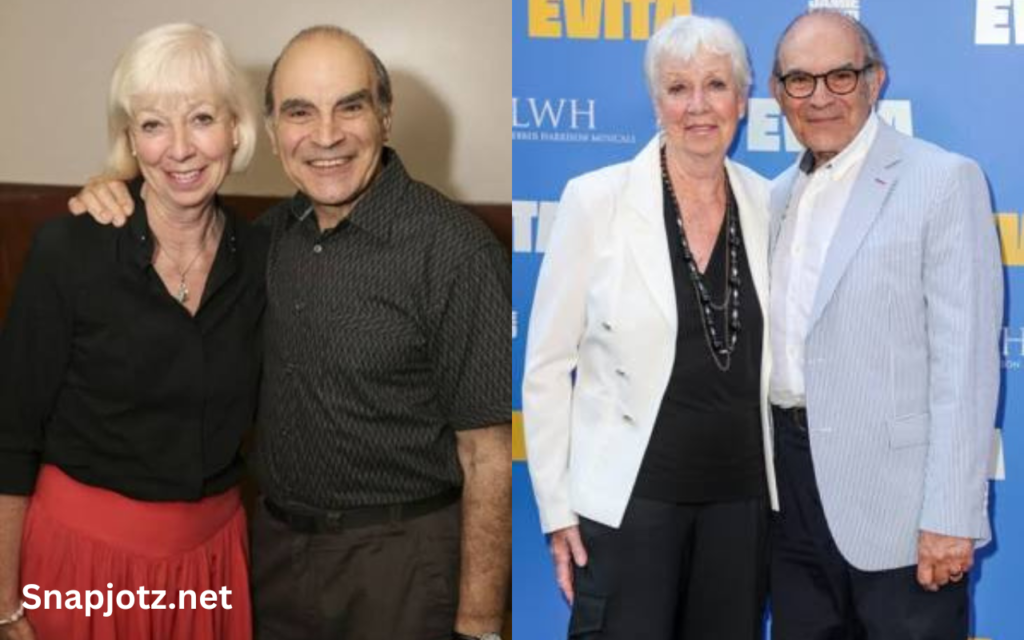

Sheila Ferris is a British actress whose life has unfolded at the intersection of theatre, television, family and one of Britain’s most enduring acting partnerships. Although she is widely recognized today as the wife of celebrated actor Sir David Suchet, Ferris had established herself as a professional performer long before her husband’s international fame. Her career included British stage productions as well as television appearances in popular programmes such as Some Mothers Do ‘Ave ‘Em, Yes Minister, Coming Home and The House of Eliott.
What makes Sheila Ferris’s story particularly interesting is that her career cannot simply be described as a short chapter preceding her marriage. Theatre records show that her professional work began years before she married Suchet and included productions with major British repertory companies and theatres. Theatricalia records performances stretching from the late 1960s through the early 1990s, including The Two Gentlemen of Verona, Oedipus Rex, The Doctor and the Devils, Measure for Measure, Rookery Nook and Shadowlands.
At the same time, Ferris has deliberately remained far more private than most people connected to a major television star. Reliable public sources provide relatively little information about her exact birth date, parents, siblings, education or personal finances. That lack of information is important when researching her biography because many websites repeat unverified details as facts. A more accurate portrait emerges when the documented record is separated from speculation: Sheila Ferris was a trained and experienced actress, a mother of two, the long-time partner of David Suchet, and a woman who chose family and privacy without completely abandoning her connection to the performing arts.
Sheila Ferris Quick Facts
| Fact | Details |
|---|---|
| Full name | Sheila Ferris |
| Profession | Actress and stage performer |
| Nationality | British |
| Birth date | Not reliably documented in major public sources |
| Age | Not reliably confirmed |
| Birthplace | Not reliably confirmed |
| Parents | Not reliably documented |
| Siblings | Not reliably documented |
| Husband | Sir David Suchet |
| Marriage | 1976 |
| Children | Robert Suchet and Katherine Suchet |
| Known television work | Some Mothers Do ‘Ave ‘Em, Yes Minister, Coming Home, The House of Eliott |
| Notable stage work | Measure for Measure, Rookery Nook, Shadowlands, The Last Confession |
| Net worth | No independently verified personal estimate available |
| No verified official public account identified | |
| X/Twitter | No verified official public account identified |
| No verified official public account identified | |
| Public profile | Private and selective |
The basic facts surrounding Ferris’s professional life are considerably easier to verify than details about her childhood. IMDb identifies her as an actress and records her marriage to David Suchet, while Theatricalia provides a substantial historical record of her theatre appearances. These sources help establish that her professional identity existed independently of her husband’s later fame.
Information about her age, parents, siblings and birthplace should be treated carefully because major authoritative biographies do not consistently publish those details. Rather than inserting an attractive but unsupported figure into a biography, it is more accurate to say that these aspects of Ferris’s private background remain undocumented in dependable public sources. The same caution applies to claims about a precise personal net worth.
Early Life, Education and the Beginning of Her Acting Journey
Much of Sheila Ferris’s early life remains outside the public record. Unlike many contemporary celebrities, she did not build her reputation through interviews, social media or a carefully documented personal brand. Consequently, there is no dependable public biography establishing her exact childhood circumstances, parents, siblings or educational history in the level of detail sometimes found for more heavily profiled performers.
Her documented professional history, however, reveals that she entered serious theatre work relatively early. Theatricalia records her involvement with the Bristol Old Vic Theatre School and Bristol Old Vic productions during the late 1960s, including The Two Gentlemen of Verona and Oedipus Rex. This is significant because the Bristol Old Vic tradition has long been associated with rigorous actor training and practical stage experience.
Ferris subsequently developed experience through repertory theatre, appearing with companies and theatres in Coventry, Colchester and Liverpool. Her early credits included The Doctor and the Devils, Confrontation, She’s Done It Again, Who Killed Santa Claus?, Under Milk Wood and Lord Nelson Lives in Liverpool 8. These productions show a performer building experience through different characters and theatrical styles rather than relying on a single breakthrough role.
Sheila Ferris and the Belgrade Theatre
The Belgrade Theatre in Coventry became one of the most important places in Sheila Ferris’s personal and professional history. She was working there as a professional actress when she met David Suchet in 1972. Their meeting occurred in the world of repertory theatre, where actors worked closely together through demanding production schedules and frequent rehearsals.
Suchet has recalled seeing Ferris at the Belgrade Theatre and being immediately captivated by her. Their relationship eventually developed into marriage, but the significance of their meeting goes beyond the romantic story frequently repeated in celebrity biographies. Ferris was already a working theatre professional at the time, meaning the couple began their relationship as colleagues within the same demanding profession.
The Belgrade connection also illustrates how strongly theatre shaped Ferris’s life. She and Suchet were not introduced through Hollywood, television publicity or a celebrity event. Their relationship began in the rehearsal rooms and stages of British repertory theatre, an environment in which both performers were developing their craft. That shared professional foundation later became an important part of their enduring relationship.
Sheila Ferris’s Professional Acting Career
Sheila Ferris’s television career included several recognizable British productions. IMDb lists appearances in Graham’s Gang, Miss Jones and Son, Some Mothers Do ‘Ave ‘Em, Yes Minister, Coming Home and The House of Eliott. Her roles were generally supporting or character parts, including a nurse, Kitty, a Topic Director, a ticket clerk and Mrs. Rowse.
Her appearance in Yes Minister is particularly notable because the programme remains one of Britain’s best-known political sitcoms. British Comedy Guide records Ferris as the “Topic” Director in the 1980 episode “Big Brother.” The same source records her appearance as a nurse in Some Mothers Do ‘Ave ‘Em and Kitty in Miss Jones and Son.
In The House of Eliott, Ferris played Mrs. Rowse in an episode of the period drama. IMDb records the appearance in 1992, demonstrating that her television work continued well beyond the period immediately following her marriage to Suchet.
Her Theatre Career and Range as a Performer
Theatre was arguably the most substantial foundation of Ferris’s acting career. Her stage credits include productions of Shakespeare, comedy, drama and contemporary theatrical works. Theatricalia records her as Francisca in Measure for Measure, the Whore in The Devil Is an Ass, Clara Popkiss in Rookery Nook, and a registrar or nurse in Shadowlands.
Her appearance in Measure for Measure is particularly useful in understanding the seriousness of her theatrical background. The production was associated with the Birmingham Repertory Company and appeared at the National Theatre’s Lyttelton Theatre. This type of work placed Ferris within the professional British theatre circuit rather than the more limited world of television guest appearances.
The range of her stage credits also demonstrates versatility. Moving between Shakespearean drama, comedy and modern dramatic material requires performers to adjust their vocal delivery, physicality and approach to characterization. Ferris’s career therefore reflects the kind of adaptable stage training that was central to the careers of many British actors of her generation.
Marriage to David Suchet
Sheila Ferris married David Suchet in 1976 after the couple had met several years earlier at the Belgrade Theatre. IMDb records their marriage as beginning on July 31, 1976, while other sources give June 30, 1976, as the wedding date. The year of their marriage is consistently reported, while the discrepancy over the exact day illustrates why small biographical details should be verified before being presented as certain.
At the time of their marriage, Suchet was still developing the career that would eventually make him internationally famous. He had not yet become synonymous with Hercule Poirot, and the couple’s life therefore began during a much less glamorous period of the acting profession. Like many performers, they experienced the uncertainty and financial pressures that can accompany theatrical work.
Suchet has spoken warmly about Ferris over the years and has credited her with being an important source of support. In an interview with Ginny Dougary, he described her as a major presence in his life and recalled the financial difficulties they experienced when they were younger. His comments offer an unusually personal glimpse into the sacrifices made by both partners during the early years of their marriage.
Family Life and Children
Sheila Ferris and David Suchet have two children, Robert Suchet and Katherine Suchet. IMDb confirms that the couple have two children and identifies Katherine Suchet in its family information, while its biography section also identifies Robert as their son.
Family responsibilities became a major factor in Ferris’s professional decisions. In a 2014 interview about The Last Confession, Suchet explained that Ferris had stepped away from the stage to look after their children and described the decision as giving up a promising career. His comments make clear that the choice was significant rather than casual.
The family’s experience also illustrates the practical realities of working in the performing arts. Theatre and television careers can involve long rehearsals, irregular schedules, travel and financial uncertainty. For Ferris and Suchet, balancing those demands with raising children required decisions that were not necessarily visible to the public but had lasting consequences for their careers.
Why Sheila Ferris Stepped Away From Acting
One of the most frequently repeated descriptions of Ferris is that she “gave up acting” after marrying Suchet. That statement contains some truth but is too simplistic when viewed against her complete professional record. She continued to appear in television and theatre after the birth of her children, although her professional activity became much less frequent.
Suchet himself acknowledged the sacrifice in interviews. Speaking about Ferris’s return to theatre in 2014, he said she had given up a “wonderful career” to look after their children. He also explained that the family did not have the money to employ help during the earlier years, making her decision particularly practical as well as personal.
The decision can therefore be understood as a change in priorities rather than the end of Ferris’s identity as an actress. Her later return to professional theatre showed that her connection with acting remained intact. The years away from regular performance became one chapter of her life rather than a complete rejection of her original profession.
Sheila Ferris During the Poirot Years
David Suchet’s portrayal of Hercule Poirot became the defining role of his career. He played the Belgian detective across 70 episodes of Agatha Christie’s Poirot, with the final episode, “Curtain: Poirot’s Last Case,” completing the television adaptation in 2013. The series turned Suchet into an internationally recognized figure.
During those years, Ferris remained largely outside the public spotlight. Her contribution was therefore different from the conventional role of a celebrity spouse appearing at premieres and publicity events. Suchet has repeatedly spoken about her support, including the practical help she provided while he prepared for demanding acting work.
That private partnership became particularly important because playing Poirot required extraordinary consistency over many years. The character demanded a precise accent, physical mannerisms, memorized dialogue and detailed preparation. Ferris’s support took place behind the scenes, but Suchet’s comments suggest that she was deeply involved in helping him manage the pressures of his profession.
The Return to the Stage in The Last Confession
One of the most meaningful moments in Sheila Ferris’s later career came with The Last Confession. The production focused on the final days of Pope John Paul I and brought Ferris and Suchet back onto the same stage. Suchet played the central role while Ferris portrayed a nun who cared for the pope.
In his 2014 interview with Jo Litson, Suchet confirmed that Ferris was playing the only female role in the production and said it had been more than 20 years since she had last appeared on stage. He described the production as an opportunity for her to return to theatre and said she was enjoying the experience.
The reunion had a strong symbolic quality because the couple had met through theatre decades earlier. The Los Angeles Times likewise reported that Ferris and Suchet had met in a 1972 production of Dracula and were now performing together again. For Ferris, the return was not merely another acting credit; it represented a reconnection with the profession that had shaped her early adult life.
Personal Life and Private Nature
Perhaps the strongest defining feature of Sheila Ferris’s public image is her privacy. She has not cultivated the kind of social-media presence now expected from celebrities, and there is no reliably verified official Instagram, X/Twitter or LinkedIn account that can confidently be attributed to her. This makes her very different from contemporary entertainment personalities who communicate with fans every day.
Her limited public profile also means that information about her hobbies, daily routines and personal opinions should not be invented. There are occasional descriptions of family life surrounding David Suchet, but Ferris herself has rarely provided the kind of extensive personal commentary that would allow a detailed account of her private habits.
That restraint appears consistent with the way she has approached fame throughout her marriage. Even after Suchet became internationally famous, Ferris did not transform herself into a media personality. Her public appearances have generally been connected with acting, family, charitable events or her husband’s professional life rather than self-promotion.
Sheila Ferris as Lady Suchet
David Suchet received a knighthood in the 2020 Birthday Honours for services to drama and charity. As his wife, Sheila Ferris is consequently known formally as Lady Suchet. The title reflects her husband’s honour rather than a separate acting award received by Ferris herself.
The change in title did not appear to transform Ferris’s public lifestyle. She remained a relatively private figure rather than using the honorific as a platform for celebrity publicity. This is consistent with the broader pattern of her life, in which public recognition has generally remained secondary to family and personal commitments.
The title also adds another chapter to a relationship that began when two young actors were working together in repertory theatre. From a Coventry stage in the early 1970s to the world of international television fame, their partnership has endured through an extraordinary period of change in British entertainment.
Charity and Recent Public Life
Ferris has occasionally appeared publicly alongside Suchet for charitable and community-related activities. One documented example came in October 2023, when she and Sir David Suchet visited University College London Hospitals and met volunteers, patients and staff at University College Hospital’s Macmillan Cancer Centre. UCLH identified Ferris publicly as Lady Suchet during the visit.
The appearance is representative of the kind of public activity associated with Ferris in later life. Rather than seeking entertainment headlines, she has appeared in contexts where the focus is on community, healthcare, family or causes important to the couple.
There is no reliable evidence of a major new acting project for Ferris in 2026. Her last clearly documented stage appearance remains The Last Confession, while her more recent public profile has centered largely on family life and occasional appearances with Suchet. That does not necessarily mean she has completely closed the door on performance, but there is currently no solid evidence of a regular new television or theatre career.
Sheila Ferris Net Worth and Sources of Income
A precise personal net-worth figure for Sheila Ferris cannot responsibly be stated from the available evidence. Celebrity wealth websites sometimes publish exact numbers, but without access to private financial records, property documentation or verified income statements, such figures are essentially estimates.
Ferris’s historical income would have come primarily from her acting career in theatre and television. Her credits include numerous professional stage productions as well as television roles, but the available public record does not provide reliable information about her individual salaries, contracts or accumulated assets.
It is also important not to confuse David Suchet’s wealth with Ferris’s personal net worth. The couple are married and have shared a long family life, but their individual finances are not publicly disclosed in sufficient detail to calculate a trustworthy figure. The most accurate conclusion is therefore that Sheila Ferris’s net worth is private and not independently verified.
Awards, Recognition and Professional Legacy
Sheila Ferris does not have a widely documented list of major individual acting awards comparable with the honors received by her husband. That does not diminish the value of her career. Much of British theatre and television has historically depended on performers whose work is remembered through productions rather than award ceremonies.
Her stage record is particularly significant because it connects her with respected theatrical institutions and a wide variety of dramatic material. Her credits with the Bristol Old Vic, Belgrade Theatre, Birmingham Repertory Company, Liverpool Playhouse and other venues demonstrate a substantial professional foundation.
Ferris’s most unusual form of recognition may therefore be longevity and association. She has remained connected to the British acting world for decades, while also building a private family life alongside one of Britain’s best-known performers. Her story demonstrates that a career does not have to be dominated by leading roles or awards to have genuine professional value.
What Sheila Ferris’s Story Teaches Us
The most important lesson from Sheila Ferris’s biography is that success can take different forms at different stages of life. Early in her career, success meant working as a professional actress and developing experience on British stages. Later, it meant raising a family and supporting the people closest to her. Eventually, it included returning to theatre when the opportunity arose.
Her story also challenges the tendency to define women connected to famous men solely through their relationships. Ferris was an actress before she became known as David Suchet’s wife, and her theatrical record makes that clear. At the same time, reducing her story to career achievements alone would also miss the significance of her family choices and the role she played in a decades-long partnership.
Perhaps most importantly, Ferris demonstrates that stepping away from a profession does not erase the identity built through that profession. Her appearance in The Last Confession showed that after more than two decades away from the stage, she could return to the environment where her professional life had begun.
Conclusion: The Quiet Legacy of Sheila Ferris
Sheila Ferris’s life is a fascinating example of a career that developed away from the glare of celebrity culture. She built a genuine professional identity through British theatre and television, appeared in respected productions, married David Suchet in 1976, raised two children and eventually returned to the stage after a lengthy absence. Her story is therefore considerably richer than the simple label of “David Suchet’s wife.”
Her greatest legacy may lie in the balance she created between artistic ambition and family commitment. Ferris experienced the uncertainty of the acting profession, made difficult choices when her children needed her, and later rediscovered the stage. Meanwhile, her marriage to Suchet developed from a meeting between two young actors into one of the enduring partnerships associated with British theatre and television.
As Sheila Ferris continues to live largely away from the demands of celebrity publicity, her journey offers a quieter but powerful lesson about perseverance and personal choice. Fame is not the only measure of a meaningful life, and visibility is not the same thing as influence. Her career, family and enduring connection to the performing arts show how resilience, sacrifice, love and passion can combine to create a legacy that does not need to shout to be remembered.